
Print on Demand Book Publishers
Best Print on Demand Book Publishers & Printing Services (Complete Guide)
Independent publishing has exploded, and print on demand sits at the heart of that change. Authors no longer print thousands of copies and hope they sell. Instead, they print one book at a time, exactly when a reader orders it.
This shift has removed the biggest barriers to publishing: cost, risk and storage. A first-time author can now publish a professional paperback without spending lakhs on a print run.
Print on demand, or POD, powers most modern self-publishing. It is the engine behind Amazon books, bookstore distribution and author-run online stores.
This guide is your complete resource on POD book publishing. You will learn how it works, who the best providers are, what it costs, and how to choose the right partner. Whether you write fiction, poetry, non-fiction or academic books, this guide will help you publish smarter.
Quick answer: Print on demand is a publishing model where each book is printed only after a customer orders it. It removes inventory, lowers risk, and lets authors keep higher royalties while reaching global readers.
What is Print on Demand Book Publishing?
Print on demand book publishing is a model where a book is printed only when someone orders a copy. There is no bulk printing and no stored inventory. The platform prints, packs and ships each book individually, then pays the author a share of the sale.
This is the opposite of traditional printing. Instead of printing 1,000 copies upfront, you print one copy at a time, on demand.
POD has three defining features.
Inventory-free publishing. You never hold stock. No boxes of unsold books fill your home or warehouse.
One-copy printing model. Each order triggers a single print run. A reader buys one book, and one book is printed.
Low risk and low cost. You avoid large upfront printing bills. You only pay print costs when a sale happens, usually deducted from your earnings.
Featured snippet: Print on demand (POD) is a publishing method where each book is printed only after a customer places an order. It eliminates inventory and upfront print runs, letting authors publish, sell and ship books worldwide with minimal cost and risk.
How Print on Demand Works
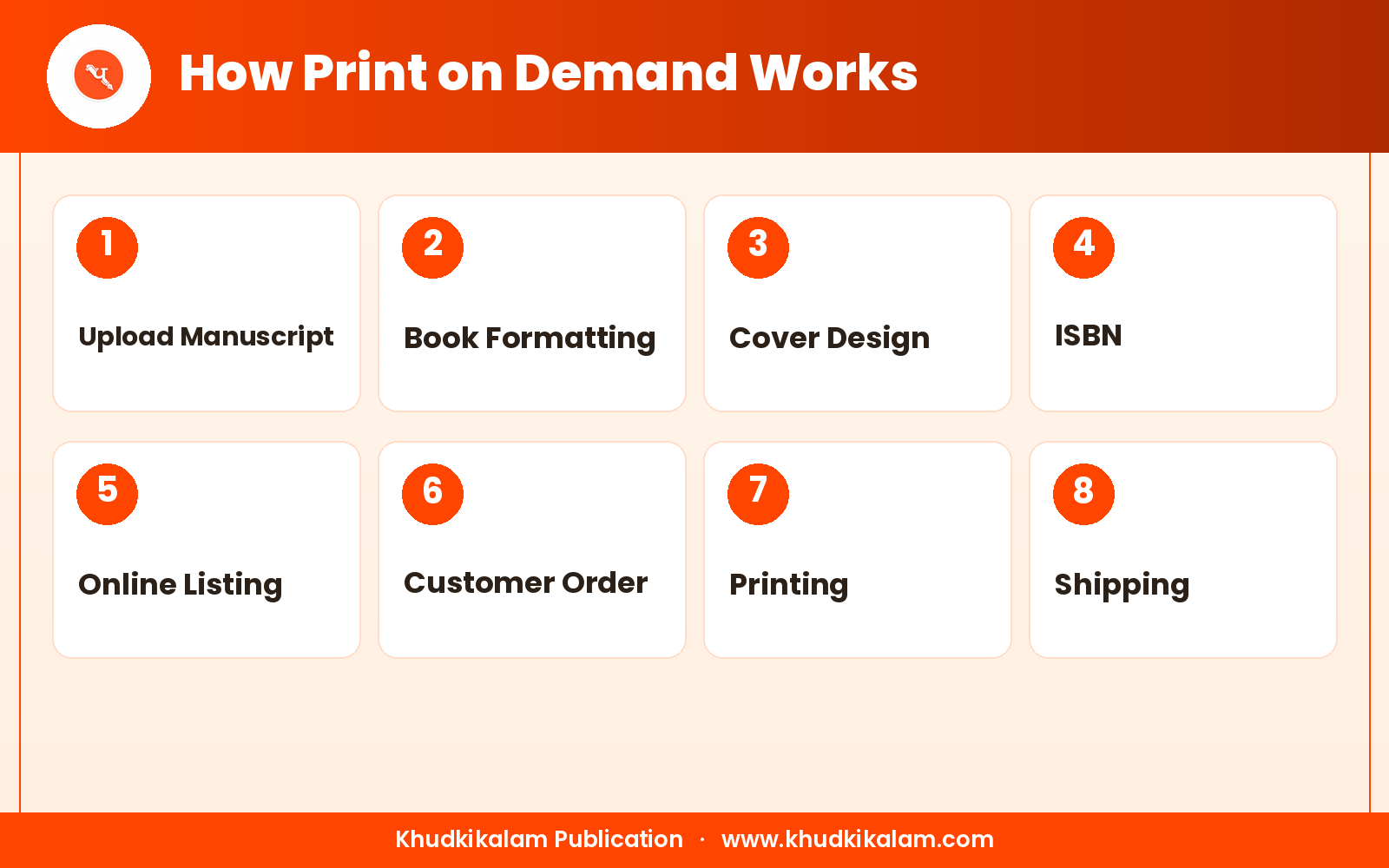
Print on demand works through a simple, automated workflow that turns your manuscript into a printed book delivered to a reader. Once set up, the process runs without you touching each order. Here is the step-by-step flow.
Print on Demand Workflow
| Step | What happens | Who does it |
|---|---|---|
| 1. Upload manuscript | You upload your finished, formatted file | Author |
| 2. Book formatting | The interior is set for the chosen trim size | Author or service |
| 3. Cover design | A print-ready cover is created and uploaded | Author or service |
| 4. ISBN | An ISBN is assigned to identify the book | Author, platform or service |
| 5. Online listing | The book goes live on stores and marketplaces | Platform |
| 6. Customer order | A reader buys a copy online | Reader |
| 7. Printing | A single copy is printed on demand | POD provider |
| 8. Shipping | The book is packed and shipped to the reader | POD provider |
After step 8, the platform deducts the print cost and its commission, then pays you the remaining royalty. The cycle repeats for every order, automatically.
Featured snippet: POD works by listing your book online, then printing a single copy each time a reader orders. The provider prints, packs and ships the book, deducts printing and platform fees, and pays the author the remaining royalty.
Why Authors Prefer Print on Demand Publishing
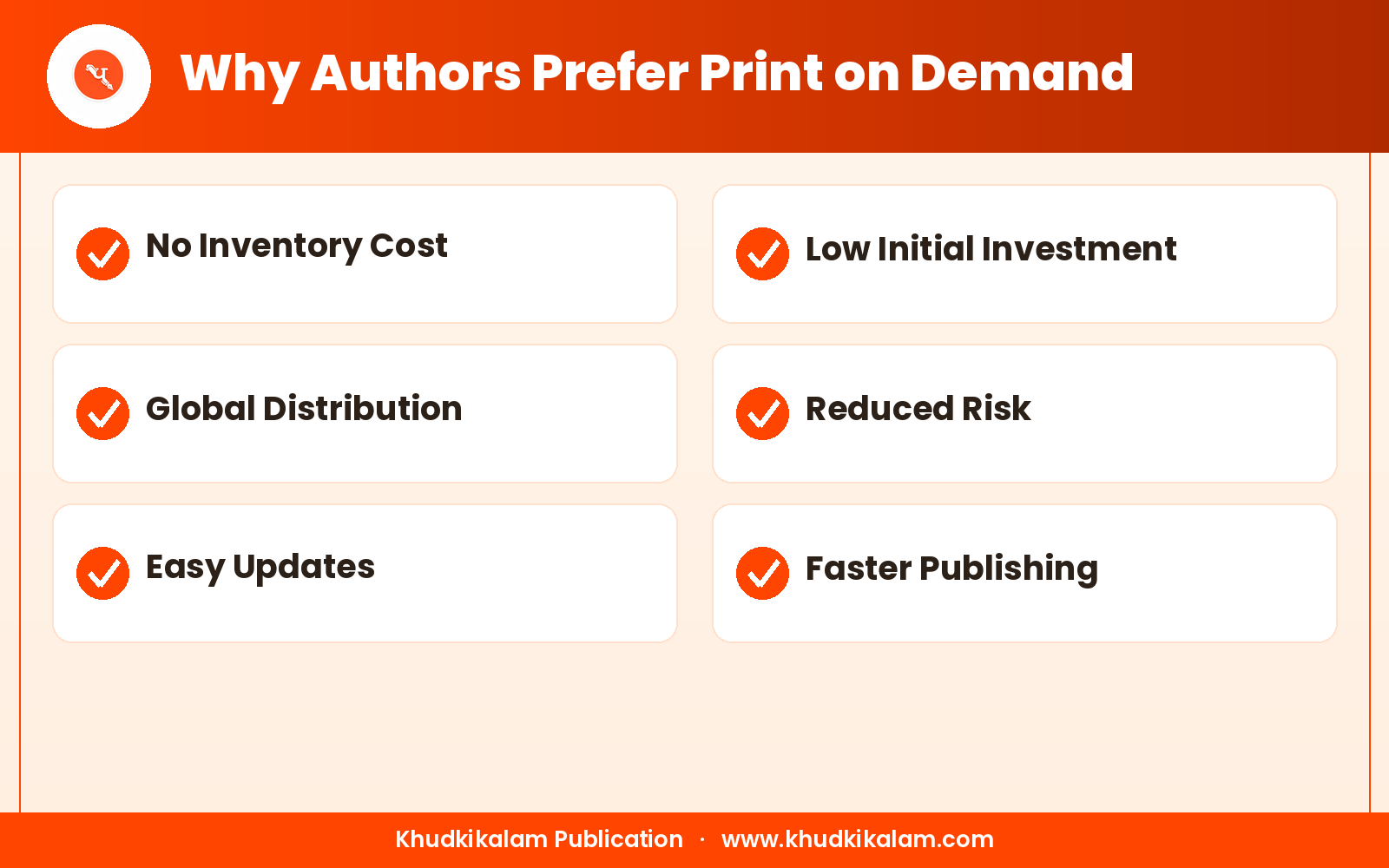
Authors prefer print on demand because it removes cost, risk and inventory while keeping creative control. POD has made publishing accessible to writers who could never afford a traditional print run. Here are the main benefits.
- No inventory cost. You hold zero stock. There are no unsold boxes and no storage worries.
- Low initial investment. You avoid a large upfront print bill. You pay printing costs only when a book sells.
- Global distribution. Your book can reach readers worldwide through Amazon, bookstores and online stores.
- Reduced risk. You never gamble on a big print run. If only ten copies sell, only ten are printed.
- Easy updates. You can fix typos or update content and upload a new file. The next copy prints with your changes.
- Faster publishing. You can move from finished manuscript to a live book in days, not months.
Expert tip: POD is ideal for testing a new book. You can launch with no inventory, see how it sells, and scale up only when demand is proven.
Best Print on Demand Book Publishers and Companies
The best print on demand book publishers combine print quality, distribution, fair royalties and good support. The right choice depends on where you want to sell and how much help you need. Below are leading POD providers, compared neutrally.
1. Khudkikalam Publication
Overview: Khudkikalam Publication is an author-focused Indian publishing house offering full-service print on demand and self-publishing. Its philosophy, "We Don't Print, We Preserve Dreams," reflects a hands-on approach for first-time and independent authors.
POD features: Print on demand and bulk printing, professional formatting, cover design, ISBN assistance and ebook publishing.
Distribution: Amazon and Flipkart listings, plus wider distribution support for the Indian market.
Pricing: Affordable bundled packages, with plans from ₹9,999 covering editing, design, ISBN, printing and distribution.
Pros:
- Author-friendly, guided process from manuscript to launch.
- Transparent, affordable packages for Indian authors.
- ISBN, printing, distribution and marketing under one roof.
Cons:
- Focused on the Indian market rather than global bookstore catalogues.
- Self-publishing means the author invests in production.
Best for: Indian authors, especially Hindi and poetry writers, who want complete, supported POD publishing.
Website: www.khudkikalam.com
2. Amazon KDP
Overview: Amazon Kindle Direct Publishing is the world's most popular POD platform. It prints paperbacks and hardcovers on demand and publishes Kindle ebooks.
POD features: Free setup, paperback and hardcover POD, Kindle ebooks, proof copies and a built-in cover tool.
Distribution: Direct listing on Amazon's global marketplaces, the largest online book retailer.
Pricing: Free to publish; you pay print cost per copy. Print royalties are tiered, up to 60% and sometimes 50% depending on price and marketplace.
Pros:
- Unmatched access to Amazon's huge customer base.
- No upfront or setup fees.
- Fast publishing, often live within a day or two.
Cons:
- Distribution beyond Amazon is limited.
- Less suited to bookstore and library sales.
Best for: Authors focused on selling through Amazon.
3. IngramSpark
Overview: IngramSpark combines Lightning Source POD printing with Ingram's vast wholesale distribution. It is the go-to platform for reaching bookstores and libraries.
POD features: Paperback, hardcover and ebook POD with traditional-quality printing.
Distribution: Access to over 40,000 retailers and libraries worldwide, including Barnes & Noble and independent bookstores.
Pricing: Free title setup; you pay print costs and a small market access fee on distributed sales.
Pros:
- The widest bookstore and library distribution available.
- Professional print quality, including hardcovers.
- Free revisions and free setup.
Cons:
- Economics are more complex (wholesale discounts and fees).
- Less ideal for selling directly on Amazon.
Best for: Authors who want their book in physical bookstores and libraries.
4. Notion Press
Overview: Notion Press is a leading Indian self-publishing platform with POD printing and global distribution.
POD features: Print and ebook publishing, ISBN, plus optional editing and design.
Distribution: Amazon, Flipkart and 150+ countries.
Pricing: Free and paid packages; high author profit share.
Pros:
- Full ownership and high royalties.
- Wide global and Indian distribution.
- Flexible packages for every budget.
Cons:
- Premium services raise costs.
- Marketing depends largely on the author.
Best for: Indian authors wanting speed, ownership and global reach.
5. Pothi.com
Overview: Pothi is an Indian print-on-demand pioneer known for affordability and a DIY model.
POD features: Print on demand with pay-per-print convenience and ebook options.
Distribution: Pothi store and Amazon, with a moderate footprint.
Pricing: Low upfront cost; you pay per print.
Pros:
- Minimal upfront investment.
- Full author control and ownership.
- Good for academic and regional titles.
Cons:
- Largely hands-off, with limited full-service help.
- Smaller distribution than larger platforms.
Best for: Budget-conscious, DIY and academic authors in India.
6. BlueRose Publishers
Overview: BlueRose is an Indian self-publishing company offering POD with packages and author support.
POD features: Printing, editing, cover design and distribution in bundled plans.
Distribution: Amazon, Flipkart and wider channels.
Pricing: Paid packages, plus a free ebook publishing option.
Pros:
- Beginner-friendly guidance.
- Editing and design included in packages.
- Free ebook route available.
Cons:
- Package scope and price vary.
- Marketing depth depends on the plan.
Best for: First-time Indian authors wanting guided POD publishing.
7. White Falcon Publishing
Overview: White Falcon is a Chandigarh-based, ISO-certified self-publishing company with a hybrid POD model and transparent royalties.
POD features: Print on demand, in-house inventory option, real-time sales dashboard.
Distribution: Amazon, Flipkart and 150+ countries.
Pricing: Affordable plans; authors keep 100% of profits.
Pros:
- 100% author profit share and live royalty reports.
- Copyright registration support.
- Academic publishing via ScholarGram.
Cons:
- Premium plans needed for full features.
- Some authors report limited marketing reach.
Best for: Authors wanting transparency and global POD distribution.
8. BookBaby
Overview: BookBaby is a US-based, full-service POD and self-publishing company known for quality and hands-on support.
POD features: Paperback and hardcover printing, editing, formatting and even AI-narrated audiobooks.
Distribution: Amazon, Barnes & Noble, Apple Books and major retailers.
Pricing: Upfront paid packages, with setup and printing costs higher than most platforms.
Pros:
- Full-service support and high print quality.
- Audiobook and ebook options.
- Proactive customer service.
Cons:
- Higher cost; upfront payment and minimum orders apply.
- Less suited to budget-focused authors.
Best for: Authors wanting premium, full-service publishing and willing to invest.
9. Lulu
Overview: Lulu is a long-established POD platform, strong for authors who sell directly from their own websites.
POD features: Free publishing, paperback, hardcover and coil-bound formats, plus Shopify and WooCommerce integration.
Distribution: Lulu Bookstore, retail network, and your own ecommerce store.
Pricing: Free to publish; high royalties on direct sales, lower on external channels.
Pros:
- Excellent for selling direct to readers.
- Strong ecommerce integration.
- Good print quality and format range.
Cons:
- Higher print costs and lower external royalties.
- The interface has a learning curve.
Best for: Authors selling directly through their own online stores.
10. Blurb
Overview: Blurb specialises in premium, image-heavy books such as photo books, art books and children's titles.
POD features: High-quality printing, design tools, and Adobe and BookWright integration.
Distribution: Blurb Bookstore, plus global retail through Ingram.
Pricing: Free setup; higher print costs, with a fee to remove the Blurb watermark.
Pros:
- Premium print quality for visual books.
- Professional design tools.
- Strong for photography and art.
Cons:
- Higher printing costs.
- Less suited to plain text books.
Best for: Photographers, artists and creators of visual books.
Comparison Table – Best Print on Demand Book Companies
This table compares the leading POD providers at a glance.
| Company | POD Printing | Distribution | ISBN Support | Marketing Support | Global Reach | Beginner Friendly |
|---|---|---|---|---|---|---|
| Khudkikalam Publication | Yes | Amazon + Flipkart (India) | Yes | Yes (included) | Moderate | High |
| Amazon KDP | Yes | Amazon marketplaces | Free or own | Limited | High | High |
| IngramSpark | Yes | 40,000+ stores/libraries | Free or own | Limited | Very high | Moderate |
| Notion Press | Yes | Global + India | Yes | Optional | High | High |
| Pothi.com | Yes (POD) | Moderate | Yes | Minimal | Moderate | High |
| BlueRose | Yes | Amazon, Flipkart, wide | Yes | Optional | Moderate | High |
| White Falcon | Yes (POD) | Global + India | Yes | Optional | High | High |
| BookBaby | Yes | Major retailers | Yes | Yes (paid) | High | Moderate |
| Lulu | Yes | Direct + retail | Yes | Limited | High | Moderate |
| Blurb | Yes | Blurb + Ingram | Yes | Limited | High | Moderate |
Note: Many authors use more than one platform, for example KDP for Amazon and IngramSpark for bookstores. Mixing platforms can maximise reach.
Print on Demand vs Traditional Publishing
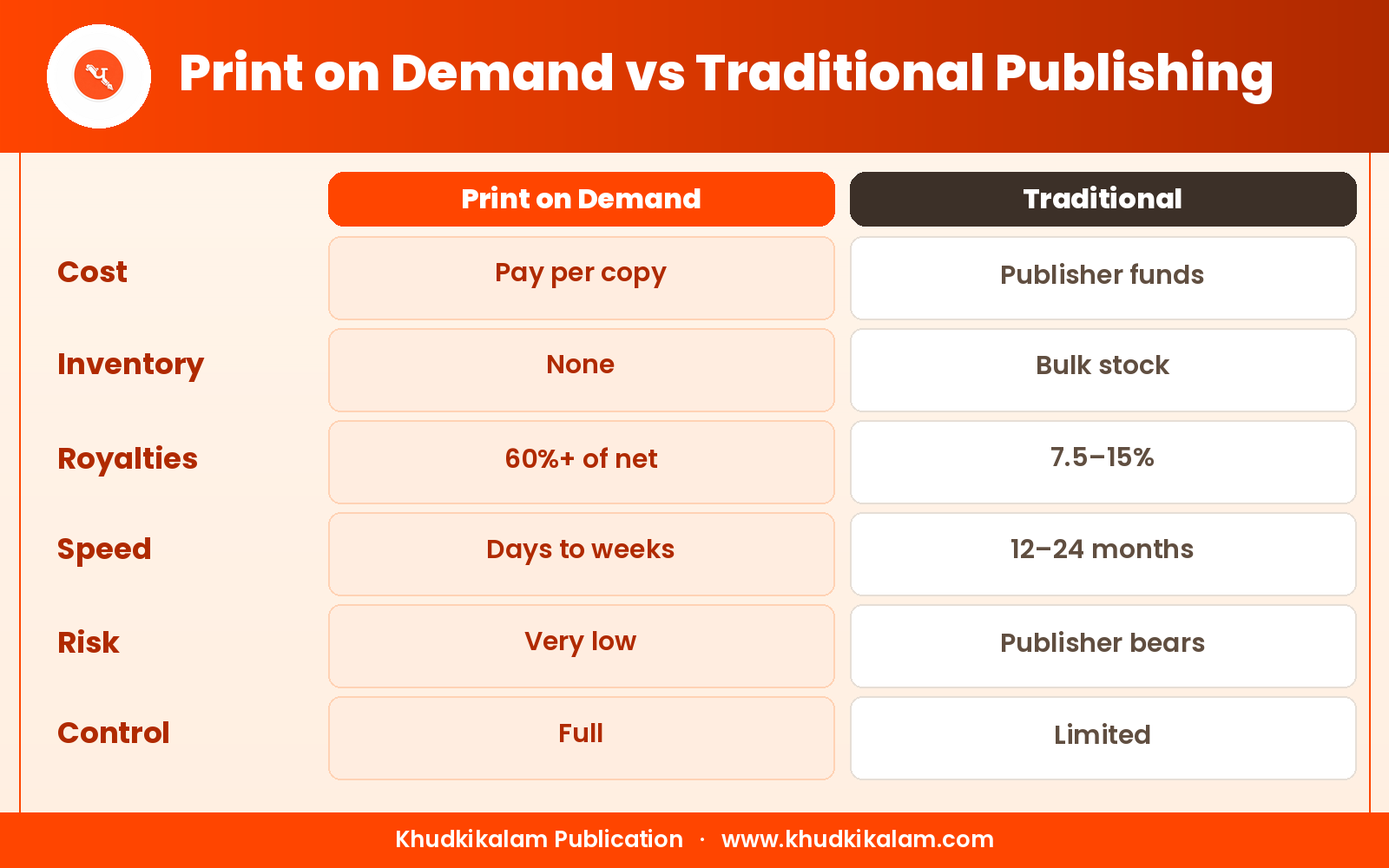
Print on demand and traditional publishing differ sharply in cost, control and speed. POD puts the author in charge; traditional publishing hands control to a publisher. The table makes the contrast clear.
| Factor | Print on Demand | Traditional Publishing |
|---|---|---|
| Cost | Low; pay per copy | Publisher funds production |
| Inventory | None; printed on demand | Bulk print runs held in stock |
| Royalties | High (often 60% or more of net) | Low (often 7.5-15%) |
| Publishing speed | Days to weeks | 12-24 months |
| Risk | Very low | Borne by the publisher |
| Author control | Full | Limited |
Expert insight: Traditional publishing offers prestige and zero upfront cost but is highly selective. POD offers speed, ownership and control to any author.
Print on Demand vs Offset Printing
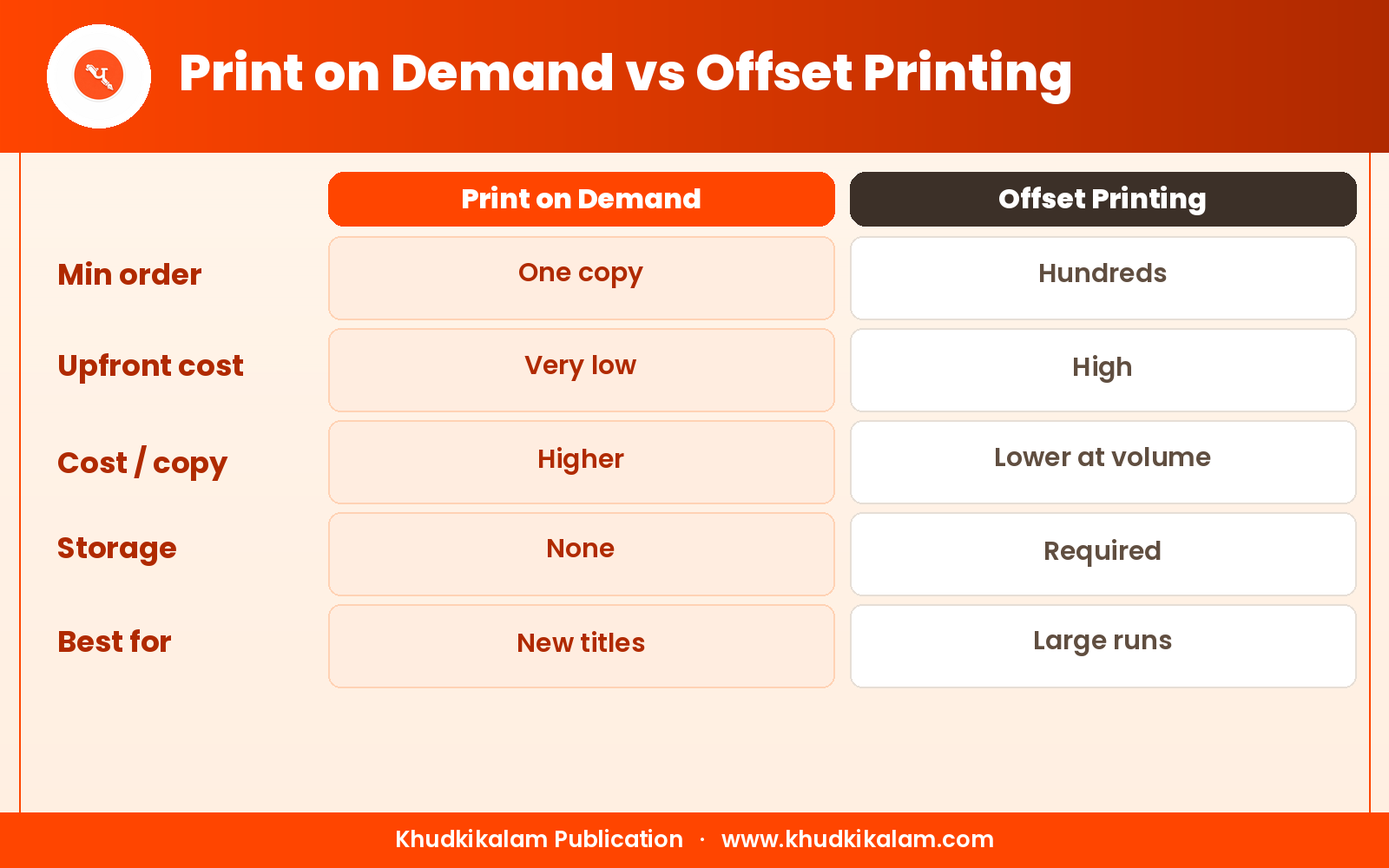
Print on demand and offset printing are two different ways to print books. POD prints single copies on demand, while offset prints large batches at once. Each suits different needs.
Bulk printing. Offset printing produces large runs, often 500 copies or more. POD prints one copy at a time.
Unit cost. Offset has a lower cost per book at high volumes. POD has a higher per-copy cost but no minimum order.
Storage. Offset requires you to store unsold stock. POD needs no storage at all.
Shipping. With POD, the provider ships each order. With offset, you handle or arrange fulfilment yourself.
POD vs Offset at a Glance
| Factor | Print on Demand | Offset Printing |
|---|---|---|
| Minimum order | One copy | Hundreds of copies |
| Upfront cost | Very low | High |
| Cost per copy | Higher | Lower at volume |
| Storage needed | None | Yes |
| Best for | New, low-volume titles | Large, proven print runs |
Expert tip: Use POD for your launch and early sales. Switch to offset only when you consistently sell large quantities and want a lower per-copy cost.
Best Print on Demand Book Sites for Authors
Several POD book sites serve different author goals. Choosing the right one depends on where and how you want to sell. Here are the leading options and their ideal uses.
Amazon KDP. Best for reaching Amazon's massive audience. Ideal for authors who want fast, free, Amazon-focused publishing.
IngramSpark. Best for bookstore and library distribution. Ideal for authors who want their book on physical shelves worldwide.
Lulu. Best for selling directly from your own website. Ideal for authors with an audience and an ecommerce store.
Blurb. Best for premium photo, art and visual books. Ideal for photographers and creative professionals.
Regional POD providers. Indian platforms like Khudkikalam Publication, Notion Press, Pothi and White Falcon suit authors targeting Indian readers with local support and Amazon and Flipkart distribution.
Callout: No single site is best for everyone. Match the platform to your audience, format and selling strategy, and consider combining two for wider reach.
Cost of Print on Demand Book Publishing
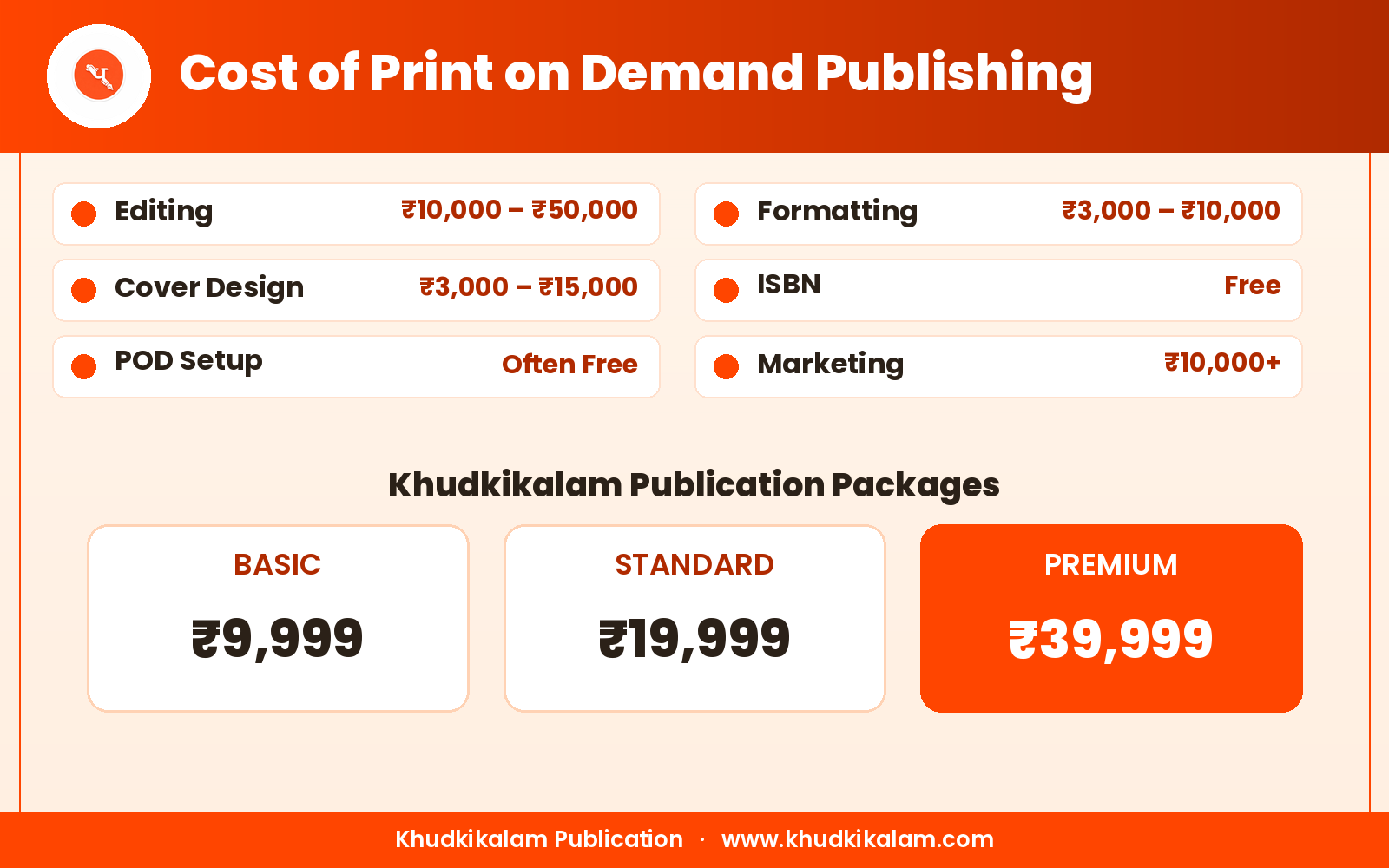
Print on demand keeps costs low because there is no upfront print run. Most platforms are free to set up; you pay only for production services and per-copy printing. The table shows realistic component costs.
Indicative POD Publishing Cost (India)
| Service | Typical cost range (INR) | Notes |
|---|---|---|
| Editing | ₹10,000 - ₹50,000 | Depends on length and depth |
| Formatting | ₹3,000 - ₹10,000 | Print and ebook layout |
| Cover design | ₹3,000 - ₹15,000 | Custom design costs more |
| ISBN | Free | Issued by the Government of India |
| POD setup | Often free | Many platforms charge nothing to list |
| Printing | Per-copy, from royalty | No upfront bulk cost |
| Marketing | ₹10,000 - ₹1,00,000+ | Scales with goals |
Bundled packages simplify budgeting for beginners. For example, Khudkikalam Publication offers plans from ₹9,999 that combine editing, design, ISBN, printing and distribution.
Factors that affect POD cost
- Page count. More pages raise the per-copy print cost.
- Colour vs black-and-white. Colour interiors cost more to print.
- Trim size and binding. Hardcovers and large formats cost more.
- Service level. Full-service packages cost more than DIY platforms.
Expert tip: With POD, your biggest spend is editing and cover design, not printing. Invest there first, because quality drives sales.
Common Mistakes Authors Make with POD Publishing
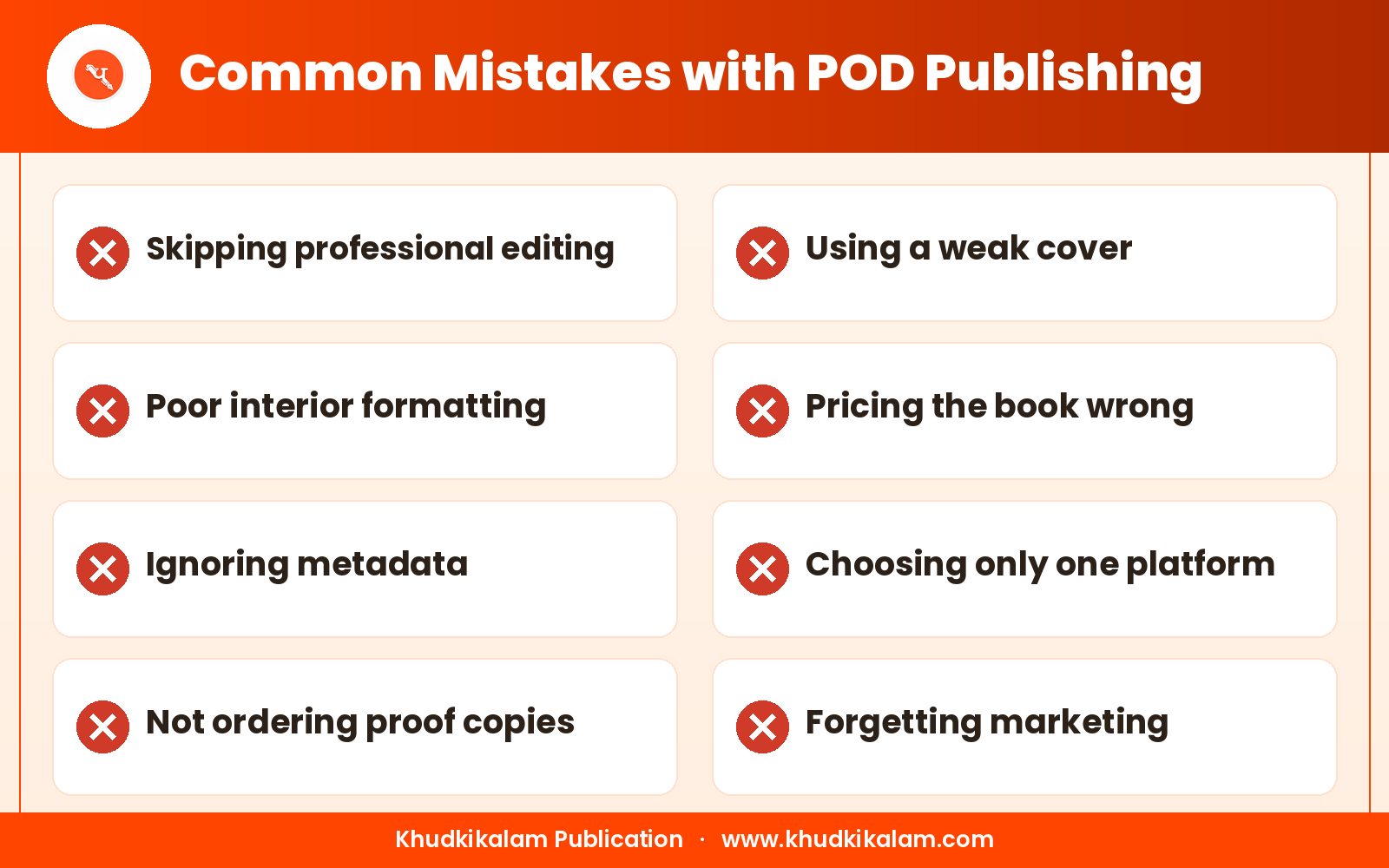
Many authors lose sales by treating POD carelessly. Avoid these eleven common mistakes.
- Skipping professional editing. Solution: always invest in editing before publishing.
- Using a weak cover. Solution: hire a professional, genre-fit cover designer.
- Poor interior formatting. Solution: format correctly for your trim size and platform.
- Pricing the book wrong. Solution: factor in print cost and royalties before setting the price.
- Ignoring metadata. Solution: write strong titles, descriptions and keywords for discovery.
- Choosing only one platform. Solution: consider KDP for Amazon and IngramSpark for bookstores.
- Not ordering proof copies. Solution: always check a physical proof before going live.
- Misunderstanding royalties. Solution: use each platform's calculator to confirm earnings.
- Forgetting marketing. Solution: plan promotion before and after launch.
- Giving away copyright. Solution: keep full ownership wherever possible.
- Expecting instant sales. Solution: treat publishing as a long-term, marketed effort.
Callout: POD makes publishing easy, but it does not make selling easy. Quality and marketing still decide success.
How to Choose the Best Print on Demand Book Publisher
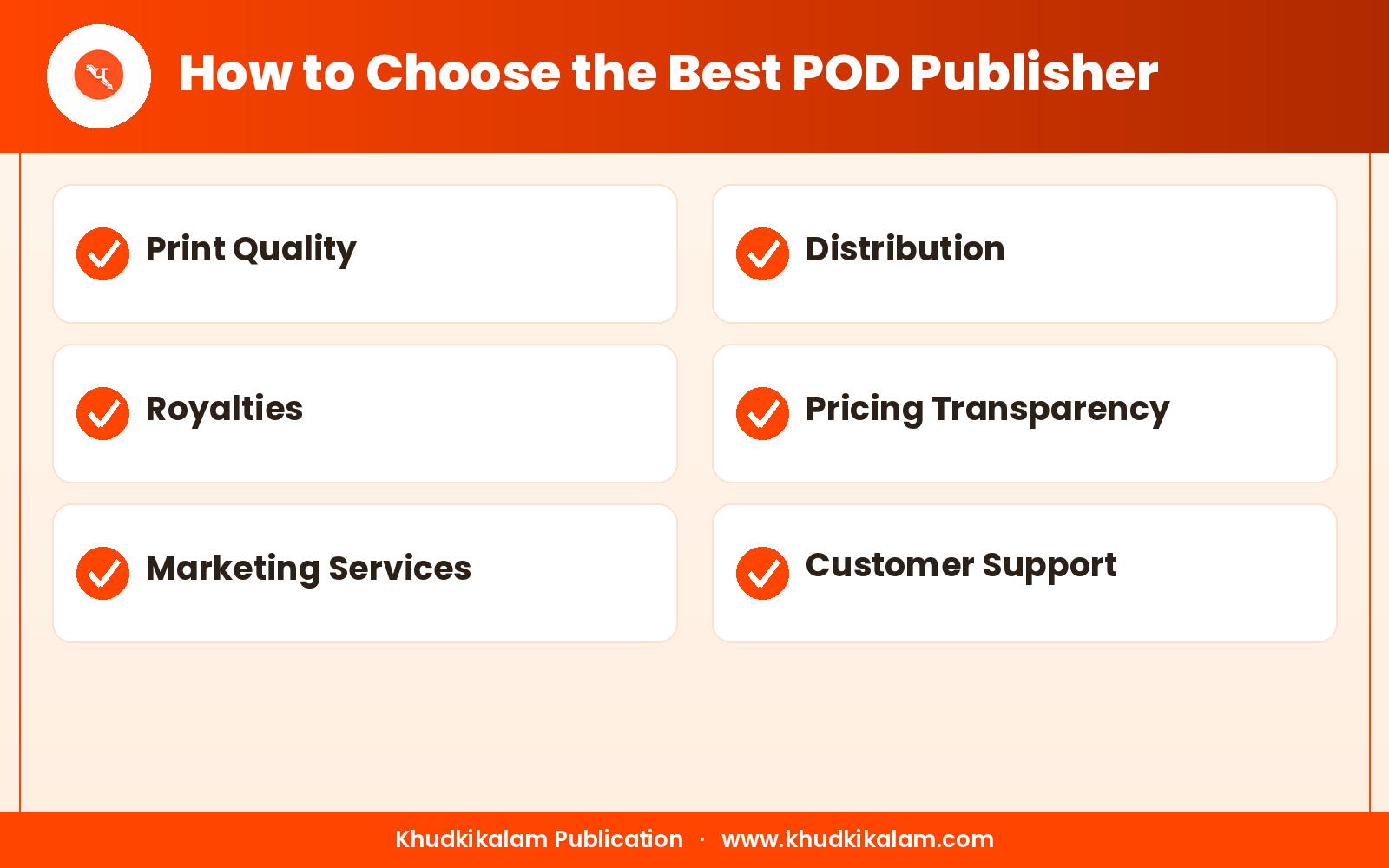
Choosing the best POD publisher means checking print quality, distribution, royalties, pricing, marketing and support. Use this checklist before you commit.
- Print quality. Order a sample. Check paper, binding and print clarity.
- Distribution. Confirm where your book will sell, online and in stores.
- Royalties. Understand exactly how much you earn per copy.
- Pricing transparency. Look for clear, itemised costs and no hidden fees.
- Marketing services. Check what promotion, if any, is included.
- Customer support. Choose a provider that answers questions quickly.
Expert tip: Match the publisher to your goal. For Amazon reach, choose KDP. For bookstores, choose IngramSpark. For full Indian support, choose a service like Khudkikalam Publication.
Is Print on Demand Worth It?
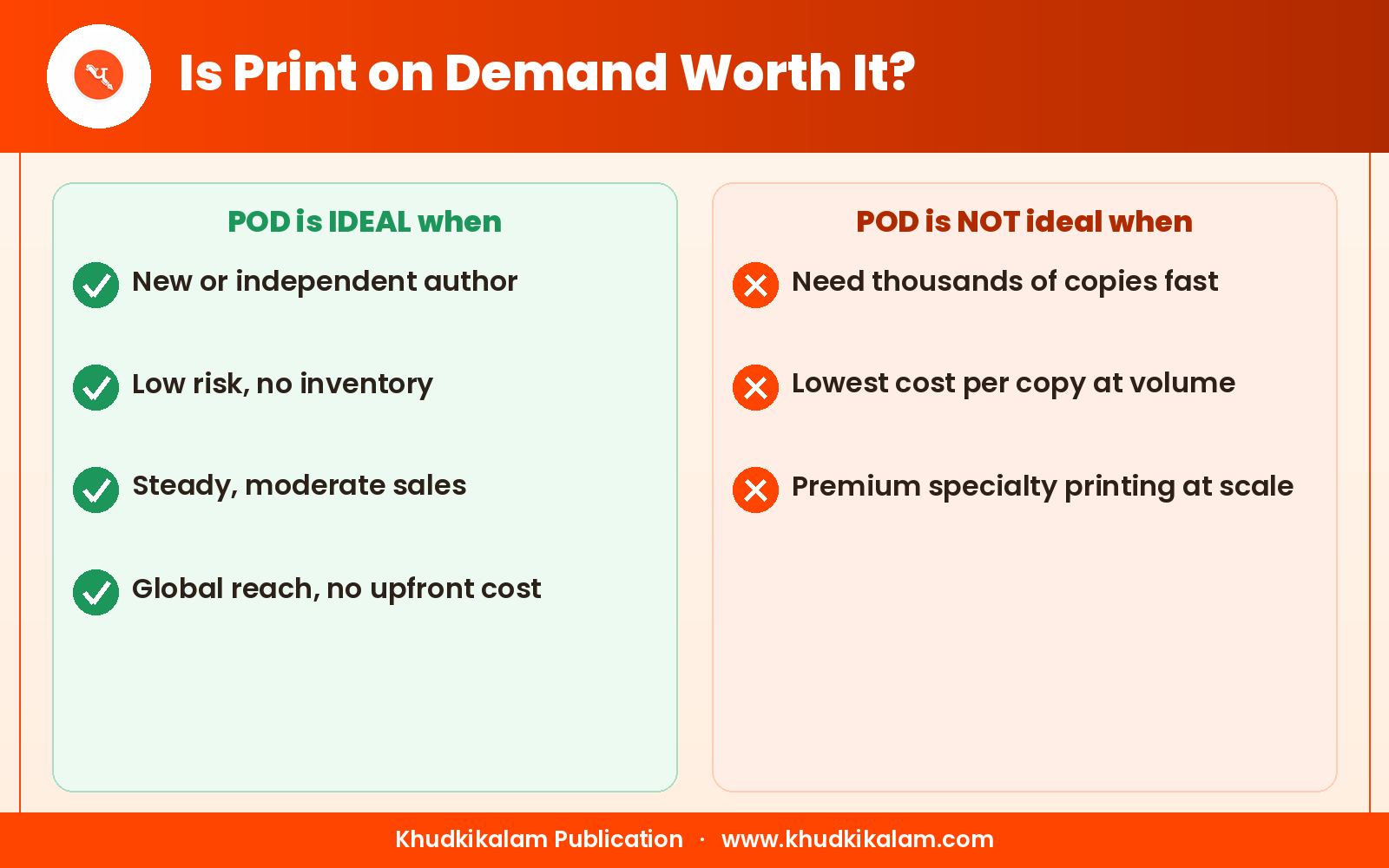
Print on demand is worth it for most independent authors because it removes cost and risk while keeping ownership. However, it is not perfect for every situation. Use this framework to decide.
When POD is ideal:
- You are a new or independent author.
- You want low risk and no inventory.
- You expect steady, moderate sales over time.
- You want global reach without upfront costs.
When POD is not ideal:
- You need thousands of copies for an event or bulk order.
- You want the lowest possible cost per copy at high volume.
- You require premium specialty printing at scale.
Decision rule: Start with POD to launch and test demand. Move to offset printing only when you consistently sell in large volumes.
Conclusion
Print on demand has transformed publishing for independent authors. It removes inventory, lowers risk, and lets you publish a professional book without a costly print run.
The best provider depends on your goal. Amazon KDP delivers Amazon reach, IngramSpark unlocks bookstores, Lulu suits direct sales, and Blurb excels at visual books. For Indian authors who want complete, supported publishing, Khudkikalam Publication brings printing, ISBN, distribution and marketing together.
Choose your platform by where you want to sell, what quality you need, and how much support you want. Invest in editing and cover design, plan your marketing, and publish with confidence.
Your book deserves to reach readers without barriers. With print on demand, it finally can.
Publish Your Book with Print on Demand
Bring your book to life with Khudkikalam Publication's print on demand publishing.
We believe "We Don't Print, We Preserve Dreams." At Khudkikalam Publication, we help first-time and independent authors publish professionally, with zero inventory and full ownership.
Here is how we support you:
- POD publishing with no bulk printing or stored stock.
- ISBN assistance so your book is properly registered.
- Professional book printing with quality paper and binding.
- Distribution across Amazon, Flipkart and beyond.
- Amazon listing to reach readers nationwide.
- Marketing support to build visibility and sales.
With affordable packages and dedicated author guidance, publishing your book has never been easier.
Ready to publish? Contact Khudkikalam Publication today for a free consultation, or explore our publishing packages. Your book is just one step away from readers.