
Self Publishing a Book in India
Self Publishing a Book in India: Complete Author Guide (2026)
Self publishing a book in India means you publish your own book without a traditional publisher, while keeping full copyright and control. You handle editing, design, ISBN, printing and distribution yourself or through a publishing service. Indian authors increasingly choose this route for faster timelines, higher royalties and complete creative freedom.
This is why thousands of first-time authors now skip the long wait for a traditional publishing deal. They write, prepare and launch on their own terms. With platforms like Amazon and Flipkart, an Indian writer can reach readers across the country and the world.
This guide walks you through everything. You will learn the publishing process, the real costs, the truth about "free" publishing, and how to choose a partner you can trust.
Quick takeaway: Self publishing puts the author in charge. You own your work, earn more per copy, and decide how your book looks, prices and sells.
What is Self Publishing?
Self publishing is the process where an author produces and releases a book independently, without signing over rights to a traditional publishing house. The author funds and manages production, keeps the copyright, and earns the majority of the royalties from each sale.
To understand where it fits, compare the three main publishing models authors use today.
Traditional publishing means a publisher accepts your manuscript, pays for production, and handles distribution. You earn a small royalty and give up most control.
Self publishing means you manage the book yourself. You pay for services, retain ownership, and earn higher royalties on every copy sold.
Hybrid publishing sits in the middle. You share some costs with a publisher and receive professional support, while keeping more rights than a traditional deal allows.
Publishing Models Compared
| Feature | Traditional | Self Publishing | Hybrid |
|---|---|---|---|
| Upfront cost to author | None | Author pays | Shared |
| Copyright ownership | Often publisher | Author | Author |
| Royalty share | Low (7-15%) | High (up to 60-70%) | Moderate (25-40%) |
| Creative control | Limited | Full | Shared |
| Time to publish | 12-24 months | 1-4 months | 3-6 months |
| Selection barrier | Very high | None | Moderate |
Expert tip: If your priority is speed, ownership and earnings, self publishing usually wins. If you want a publisher's stamp and have time to wait, traditional publishing may suit you.
Why Self Publishing is Growing in India
Self publishing is growing fast in India because digital tools, online retail and print-on-demand have removed the old barriers. Authors no longer need a publisher's approval to reach readers. They can publish a book in weeks and sell it nationwide from their laptop.
India is now one of the largest book markets in the world. The country ranks 10th globally in book publishing and produces around 90,000 titles every year, which shows how active the writing community has become.
Digital publishing growth
Internet access has changed how Indians read and buy books. India had around 886 million internet users as of 2024, and that number keeps climbing. More readers online means more demand for ebooks, audiobooks and self-published titles.
Amazon Kindle and ebook reach
Amazon Kindle Direct Publishing lets any author upload a book for free and sell it worldwide. Indian writers use it to publish ebooks within 24 to 48 hours. This speed and reach were impossible a decade ago.
Print-on-demand
Print-on-demand prints each copy only when a reader orders it. Authors avoid bulk printing costs and unsold stock. On Amazon, printing cost is deducted from your royalty rather than charged upfront, which lowers the risk for new authors.
Author ownership
Writers today value control. They want to keep their copyright, set their own prices, and market their book their way. Self publishing gives them all of this, which is a major reason the model keeps expanding.
Callout: Online retailers like Amazon and Flipkart now ship books to remote pin codes across India. A self-published author in a small town can reach a reader in any city.
Benefits of Self Publishing a Book
The benefits of self publishing go far beyond avoiding rejection letters. Authors gain ownership, income and freedom that traditional deals rarely offer. Here are the advantages that matter most to Indian writers.
- Full copyright ownership. You own every right to your book. You decide on adaptations, translations and future editions without asking anyone.
- Higher royalty earnings. Self-published authors keep a much larger share of each sale, often many times more than a traditional royalty.
- Faster publishing. You can move from finished manuscript to live book in weeks, not years.
- Creative control. You choose the title, cover, content and pricing. Nothing changes without your approval.
- Global reach. Your book can sell on Amazon worldwide and on Flipkart across India from day one.
- Marketing flexibility. You run your own campaigns, choose your audience, and adjust your strategy whenever you want.
Expert tip: Ownership compounds over time. A backlist of self-published titles can keep earning royalties for years, because you never sign those rights away.
Steps to Self Publishing a Book in India
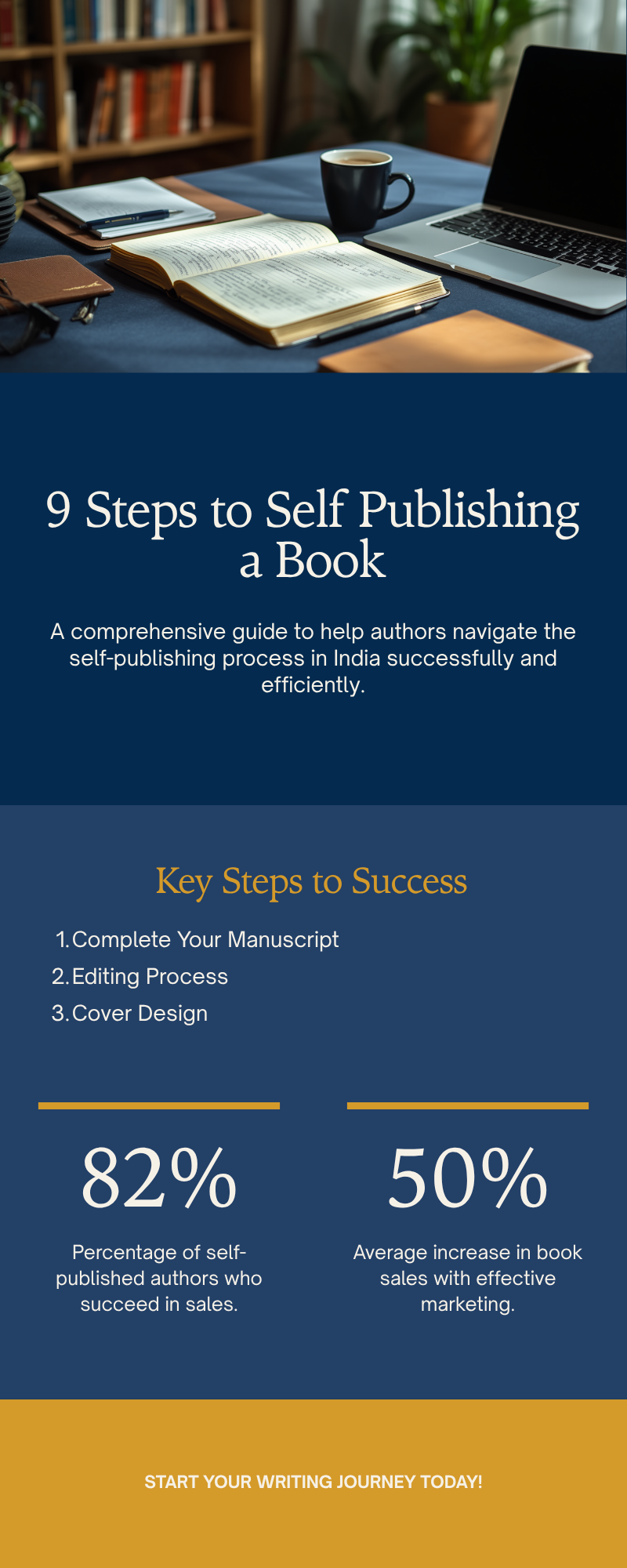
The steps to self publishing a book in India follow a clear sequence: finish your manuscript, edit it, format it, design a cover, get an ISBN, print or upload, list on Amazon and Flipkart, then market and launch. Each step builds on the last and shapes the quality of the final book.
Follow this process in order for the best result.
Step 1: Complete Your Manuscript
Finish writing your book before you think about publishing. A complete draft gives editors and designers something real to work with. Do not rush this stage, because everything else depends on it.
Step 2: Editing
Hire a professional editor to refine your manuscript. Editing covers structure, clarity, grammar and flow. Strong editing separates a polished book from an amateur one, so never skip it.
Step 3: Book Formatting
Format the manuscript for print and digital. Formatting sets the layout, fonts, margins and chapter design. Clean formatting makes your book easy to read on paper and on screen.
Step 4: Cover Design
Design a professional cover that fits your genre. Readers judge books by their covers, especially online. A strong cover lifts clicks, sales and credibility.
Step 5: ISBN Registration
Get an ISBN, the unique identifier for your book. In India, the ISBN is issued free of cost by the Raja Rammohun Roy National Agency under the Ministry of Education. Many publishing services handle this process for you so the listing stays correct.
Step 6: Book Printing
Choose your printing method. Print-on-demand suits new authors who want low risk. Offset printing suits authors who plan to sell larger quantities and want a lower per-copy cost.
Step 7: Amazon and Flipkart Listing
List your book where readers shop. Amazon and Flipkart give you national and global reach. Optimise your title, description and keywords so buyers can find your book easily.
Step 8: Marketing and Promotion
Promote your book before and after launch. Use social media, author pages, email and reviews to build interest. Marketing decides whether readers ever discover your title.
Step 9: Launch Your Book
Launch with a clear plan and a launch-day push. Encourage early reviews, share your buy links, and celebrate the release. A focused launch creates momentum that carries sales forward.
Self Publishing a Book in India Cost
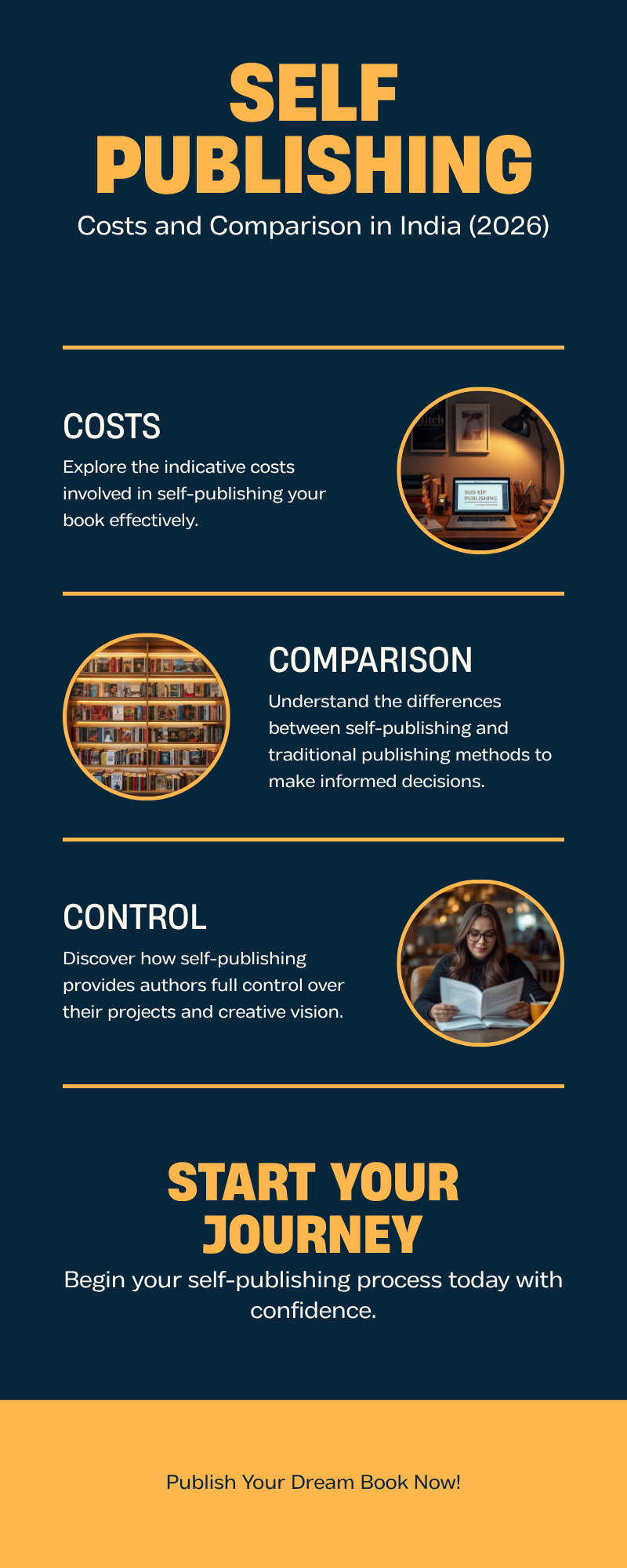
Self publishing a book in India typically costs between ₹15,000 and ₹80,000 for a standard, professionally produced title in 2026. The final figure depends on which services you need, the quality you choose, and whether you print on demand or in bulk. The table below shows realistic ranges for each component.
Indicative Self Publishing Cost Breakdown (India, 2026)
| Service | Typical cost range (INR) | Notes |
|---|---|---|
| Editing | ₹15,000 - ₹60,000 | Depends on word count and depth (proofreading vs developmental) |
| Cover design | ₹3,000 - ₹15,000 | Custom design costs more than templates |
| Formatting / typesetting | ₹3,000 - ₹10,000 | Print and ebook layout |
| ISBN | Free | Issued by the Government of India; services may charge for assistance |
| Printing (print-on-demand) | No upfront cost | Per-copy cost deducted from royalty |
| Printing (offset, bulk) | ₹10,000+ | Lower per-copy cost for large runs |
| Distribution | ₹0 - ₹15,000 | Amazon and Flipkart listing setup |
| Marketing | ₹10,000 - ₹1,00,000+ | Scales with your goals |
Note: These are indicative market ranges, not fixed quotes. Always ask a publishing partner for an itemised estimate before you commit.
Factors that affect your cost
- Manuscript length. Longer books cost more to edit, format and print.
- Editing level. Developmental editing costs more than basic proofreading.
- Print quality. Premium paper and colour interiors raise printing costs.
- Print quantity. Bulk offset printing lowers per-copy cost but needs upfront payment.
- Marketing scope. A small launch costs little; a wide campaign costs more.
Expert tip: Spend first on editing and cover design. These two areas affect sales and reviews more than anything else.
Free Book Publishers in India: Reality Check
"Free" book publishers in India usually mean platforms that charge no upfront fee, such as Amazon KDP. They are genuinely free to start, but the author still does the work or pays for quality. Truly free, full-service publishing rarely exists, and offers that sound too generous often hide conditions.
Here is what "free publishing" really involves.
What free publishing actually means. Platforms like Amazon KDP let you upload and publish without paying upfront. Instead, the platform takes a commission on each sale. You pay through royalties, not invoices.
Pros of free publishing platforms
- No upfront cost to publish your book.
- Fast access to a huge global marketplace.
- You keep your copyright and creative control.
Cons and hidden limitations
- You handle editing, design and formatting yourself, or pay for them separately.
- Quality depends entirely on your own effort and skill.
- Some "free" publishers take rights, restrict distribution, or add costs later.
- Exclusive programs may lock your book to one platform.
Callout: Free to publish is not the same as free to produce a good book. Editing, cover design and marketing still cost money or time. Read every agreement before you sign.
Cheapest Self-Publishing in India: What to Look For
The cheapest self-publishing in India is not always the best value, because low price often means low quality. The smart approach is to balance cost against print quality, royalty share and distribution reach. A slightly higher spend on the right services usually earns more in the long run.
Use these checks before you choose a budget option.
Cost vs quality. A cheap package that skips editing or uses a weak cover can hurt sales and reviews. Compare what each price actually includes.
Print quality. Ask for a sample copy. Check the paper, binding and print clarity. Poor print quality leads to refunds and bad reviews.
Royalty structure. Read how royalties are calculated and paid. A low package price means little if the royalty share is unfair or payments are delayed.
Distribution network. Confirm where your book will sell. Wide distribution across Amazon, Flipkart and other channels reaches more readers than a single platform.
Actionable tips for budget-conscious authors
- Always request a physical sample before paying for a full print run.
- Get the royalty terms and payment schedule in writing.
- Prioritise editing and cover design over extras you do not need.
- Avoid any contract that takes your copyright in exchange for a low price.
Expert tip: Judge a service by total value, not the headline price. The cheapest quote can become the most expensive mistake if your book underperforms.
How to Choose the Right Self Publishing Book Company
Choosing the right self publishing book company means checking experience, author support, printing quality, distribution, marketing and reviews before you commit. The right partner protects your rights, produces a quality book, and helps you reach readers. Use a clear checklist so no important detail slips through.
Author's Publishing Partner Checklist
| Criteria | What to verify | Why it matters |
|---|---|---|
| Experience | Years active, titles published | Proven partners avoid costly mistakes |
| Author support | Dedicated point of contact | You get guidance at every step |
| Printing quality | Sample copy, paper, binding | Quality drives reviews and repeat sales |
| Distribution | Amazon, Flipkart, wider reach | More channels mean more readers |
| Marketing support | Launch help, promotion options | Marketing decides discoverability |
| Reviews | Author testimonials, ratings | Real feedback reveals reliability |
| Copyright terms | Author retains full rights | You should always own your book |
| Transparent pricing | Itemised, written quote | No hidden charges later |
Callout: A trustworthy company keeps you in control. If a service wants your copyright or hides its pricing, treat that as a warning sign.
Common Mistakes New Authors Make
New authors often lose sales and credibility by skipping key steps in the publishing process. Most of these mistakes are easy to avoid once you know them. Here are ten common errors and how to fix each one.
- Skipping professional editing. Solution: Always hire an editor. Errors damage reviews and trust.
- Using a weak cover. Solution: Invest in a professional, genre-appropriate cover design.
- Poor formatting. Solution: Format properly for both print and ebook so the book reads cleanly.
- Ignoring the ISBN. Solution: Register an ISBN so your book is properly identified and distributed.
- Pricing wrongly. Solution: Research similar titles and price within reader expectations.
- No marketing plan. Solution: Plan promotion before launch, not after.
- Publishing on one platform only. Solution: List on Amazon, Flipkart and other channels for wider reach.
- Writing a vague book description. Solution: Write a clear, keyword-rich blurb that sells the book.
- Forgetting reviews. Solution: Ask early readers for honest reviews to build social proof.
- Signing away rights. Solution: Read every contract and keep your copyright.
- Rushing the launch. Solution: Prepare your listing, links and audience before release day.
Expert tip: Most author regrets trace back to skipping editing or marketing. Treat both as essential, not optional.
Self Publishing vs Traditional Publishing
Self publishing and traditional publishing differ most in cost, royalties, ownership, speed, control and marketing. Traditional publishing pays upfront but limits your control and earnings. Self publishing asks you to invest, but rewards you with ownership and higher royalties. The table makes the contrast clear.
Self Publishing vs Traditional Publishing
| Factor | Self Publishing | Traditional Publishing |
|---|---|---|
| Cost | Author invests in production | Publisher funds production |
| Royalties | High (up to 60-70%) | Low (7-15%) |
| Ownership | Author keeps full rights | Publisher often holds rights |
| Speed | 1-4 months | 12-24 months |
| Control | Full creative control | Limited author control |
| Marketing | Author-led and flexible | Publisher-led, often limited for new authors |
Callout: Many publishers offer little marketing support to debut authors. With self publishing, you control the campaign and the budget yourself.
Conclusion
Self publishing a book in India puts you in full control of your work, your earnings and your timeline. You own the copyright, earn higher royalties, and decide how your book looks and sells. With Amazon, Flipkart and print-on-demand, your title can reach readers across India and the world.
The process is clear once you break it down: write, edit, format, design, register an ISBN, print, list, market and launch. The cost is manageable, especially when you start with print-on-demand and invest first in editing and cover design. "Free" publishing is real but limited, so always read the fine print and protect your rights.
Your manuscript deserves a professional, trustworthy launch. With the right publishing partner, self publishing a book in India becomes simple, rewarding and built around you, the author.
Publish Your Book with Khudkikalam Publication
Your story is ready. Now let us help you share it with the world.
At Khudkikalam Publication, we guide first-time authors, poets, novelists and educational writers through every stage of self publishing in India. You keep full ownership of your book, while our team handles the heavy lifting with care and transparency.
Here is how we support you:
- Free consultation to plan your publishing journey from the start.
- End-to-end publishing assistance including editing, formatting and ISBN.
- Professional book printing with print-on-demand and bulk options.
- Wide distribution across Amazon, Flipkart and more.
- Marketing support to help readers discover your book.
You wrote the book. We will help you publish it, print it, distribute it and promote it, all with a process built around the author.
Ready to begin? Contact Khudkikalam Publication today for your free consultation and take the first step toward becoming a published author in India.